96. A pH gradient at electrode–electrolyte interface for tandem reactions
Kaiyue Ji, Yuanbo Liu, Kejian Kong, Zhihong Chau, Xiang Liu, Bo-Jun Yuan, Xi Wang, Xingjian Xu & Haohong Duan*
Nat. Commun. 2026.
DOI: 10.1038/s41467-026-72802-0

Abstract
Tandem reactions enable the sequential synthesis of value-added chemicals, as exemplified by the conversion of biomass-derived levulinic acid (LA) to γ-valerolactone (GVL) via hydrogenation and subsequent lactonization, with 4-hydroxyvaleric acid (HVA) as the intermediate. However, achieving such tandem electrocatalysis in a single electrolyzer is challenging because the two steps require distinct pH conditions: the former favors neutral or alkaline media, whereas the latter requires a strongly acidic medium. Here we create a pH gradient at the electrode–electrolyte interface by modifying a Pb electrocatalyst with cetyltrimethylammonium bromide (CTAB). The modified electrocatalyst shows >80% GVL selectivity and >50% Faradaic efficiency (FE) over 50–200 mA cm−2. Mechanistic studies show that ordered CTAB arrangements on the Pb surface disrupt the interfacial hydrogen-bond network, lowering the local H+ concentration near the Pb surface while maintaining higher acidity in the bulk electrolyte, thereby facilitating tandem LA-to-GVL conversion. This study demonstrates distinct microenvironment engineering for tandem electrosynthesis in a single electrolyzer.


You May Also Like
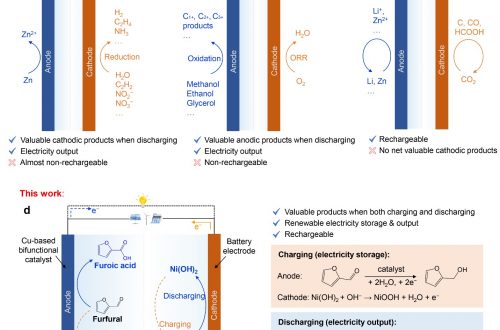
55. Rechargeable Biomass Battery for Electricity Storage/generation and Concurrent Valuable Chemicals Production

56. Electrosynthesis of N,N-dimethylformamide frommarket-surplus trimethylamine coupled withhydrogen production
