100. A paired electrolysis for hydroxymethanesulfonate synthesis using sulfide waste as the sulfur source
Chunyu Zhang, Haozhe Sun, Xiang Liu, Kejian Kong, Tiancong Zhou, Xi Wang, Haohong Duan*
Nat. Commun., 2026, 17, 8529.
DOI: 10.1038/s41467-026-75547-y
Abstract
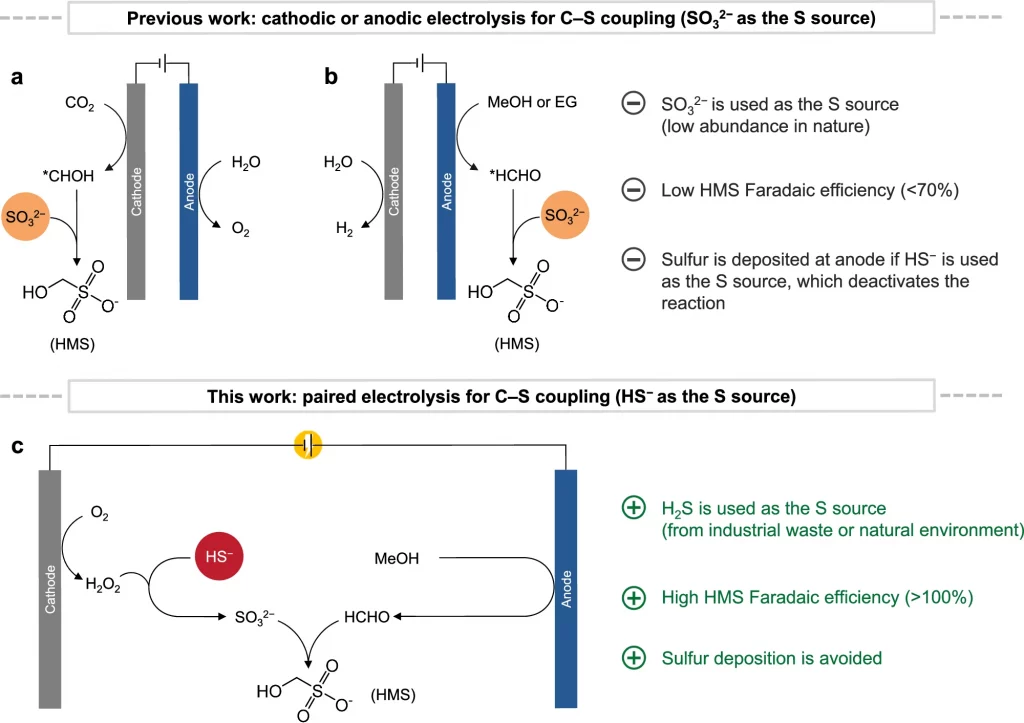
Electrochemical C–S bond construction represents an attractive route to produce valuable organosulfur compounds, yet current approaches suffer from low reaction efficiency and rely on sulfites (SO32−) as the sulfur source. Here we report a paired electrolysis for hydroxymethanesulfonate synthesis from widespread industrial-waste sulfides (HS−). Specifically, HS− is oxidized to SO32− by in-situ generated H2O2 at cathode, and methanol is oxidized to formaldehyde at anode, with following C–S coupling to form hydroxymethanesulfonate. By matching HS− concentration with current density and strengthening convective mass transfer between intermediates, we achieve efficient hydroxymethanesulfonate production with Faradaic efficiency of 102.8% and productivity of 282 μmol h−1 in a membrane-free H-cell under optimized conditions (50 mA cm−2, 0.05 M HS−, stirring in anodic chamber). By constructing a flow reactor, this paired electrolysis enables conversion of HS−-contaminated wastewater (from <10 ppm to 3000 ppm) with Faradaic efficiencies exceeding 100%, while tolerating coexisting anions and heavy metals in real effluents. It also converts waste H2S gas with >87% conversion and >74% hydroxymethanesulfonate selectivity over 102 hours of stable operation, demonstrating more cost-effective economics to both industrial and previous electrochemical methods.


You May Also Like
89. Homogeneous silver catalyst for propylene electrooxidation to propylene glycol
5. High-Performance Rh2P Electrocatalyst for Efficient Water Splitting
