97. Breaking the Kinetic Limitation of Acidic 5-Hydroxymethylfurfural Electrooxidation to 2,5-Furandicarboxylic Acid via Shared Oxygen Intermediates with Oxygen Evolution Reaction on Ir-MnOx
Peiyun Zhou, Shihao Feng, Xi Wang, Xiang Liu, Xingjian Xu, Xiubing Huang*, Haohong Duan*
ACS Catal. 2026, 16, 11, 9972–9982.
DOI: 10.1021/acscatal.6c00426
Abstract
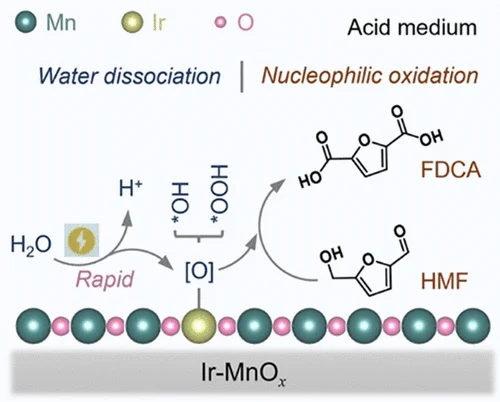
Despite the practical advantages of conducting 5-hydroxymethylfurfural (HMF) electrooxidation to 2,5-furandicarboxylic acid (FDCA) in acidic media, such as facilitated product separation and improved reactant stability over alkaline environments, the lack of efficient electrocatalysts has hindered the development of efficient acidic processes. Herein, we reveal that HMF oxidation reaction (HMFOR) shares key oxygen-containing intermediates ([O], e.g., *OH and *OOH) with oxygen evolution reaction. By incorporating Ir into manganese oxide (MnOx), the kinetic constraints of acidic HMFOR were successfully broken. Specifically, in the designed Ir-MnOx, the presence of Ir sites not only accelerates the generation of [O] species to provide abundant oxidative active species but also modulates the electronic structure of Mn sites to activate their reactivity and enhance HMF adsorption. Synergistic cooperation between Ir and Mn sites endows Ir-MnOx with a record-high HMFOR current density (56.2 mA cm−2@1.40 VRHE), along with high FDCA selectivity (94%) and yield (92%) in an acidic electrolyte (pH 1.89). This work provides mechanistic insights and a design strategy for efficient HMFOR electrocatalysts in acidic environments.


You May Also Like

1. Homogeneously Dispersed Ceria Nanocatalyst Stabilized with Ordered Mesoporous Alumina
15. Single Ru atoms with precise coordination on a monolayer layered double hydroxide for efficient electrooxidation catalysis